
Is Lottery Legal in India
Is Lottery Legal in India? Laws, State Rules and Safety Guide
Many people ask, “Is lottery legal in India?” The answer is not a simple yes or no. India allows state governments to organise lotteries under a central legal framework. However, each state can decide whether it will permit or prohibit lottery ticket sales within its territory.
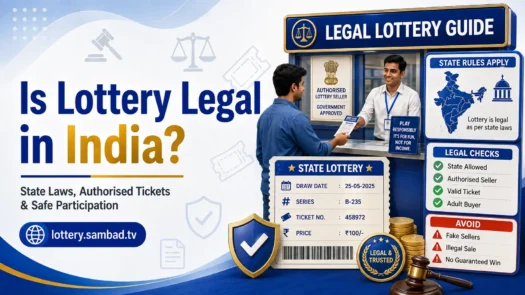
Therefore, a lottery ticket may sell legally in one state but remain restricted in another. Buyers must check the organising state, the place of purchase, the seller’s authorisation and the latest local rules before purchasing a ticket.
This guide explains Indian lottery law, state powers, authorised tickets, online lottery risks, private lottery restrictions and responsible participation.
Is Lottery Legal in India?
Government-authorised lotteries can operate legally in India when they follow the conditions of the Lotteries (Regulation) Act, 1998 and the applicable rules.
The Act extends across India and regulates how state governments may organise, conduct or promote lotteries. It also gives states the power to prohibit lottery ticket sales within their territory.
Consequently, the legal position depends on several questions:
- Does a state government organise or authorise the lottery?
- Does the lottery follow the conditions under central law?
- Does the buyer’s state allow the sale of that ticket?
- Does an authorised distributor or seller provide the ticket?
- Does the buyer follow local eligibility requirements?
A ticket does not become legal merely because a website, shop or social-media account offers it.
Which Law Regulates Lotteries in India?
The main central law is the Lotteries (Regulation) Act, 1998. Parliament enacted this law to regulate lotteries and related matters.
The Act contains provisions concerning:
- The meaning of a lottery
- Prohibition of unauthorised lotteries
- Conditions for state-organised lotteries
- State power to prohibit ticket sales
- Penalties for violations
- Government directions and rule-making powers
India Code lists the Act under the Ministry of Home Affairs and shows that it applies throughout India.
What Is the Lotteries Regulation Act, 1998?
The Act defines a lottery as a scheme that distributes prizes by chance among people who purchase tickets.
However, the law does not allow just any private person or company to launch a lottery. Instead, it establishes a regulated system under which a state government may organise, conduct or promote a lottery subject to specific conditions.
Therefore, buyers should distinguish between:
- A government-organised or authorised lottery
- An unauthorised private lottery
- A promotional prize competition
- An online gambling or betting platform
- A fraudulent lucky-draw message
These activities do not automatically follow the same legal rules.
What Are the Lotteries Regulation Rules, 2010?
The Central Government introduced the Lotteries (Regulation) Rules, 2010 under the 1998 Act.
The rules provide additional operational guidance and define terms connected with paper and online lottery systems, organising states, distributors, selling agents, draws and central computer systems.
For example, the rules describe a distributor or selling agent as a person or legal entity that an organising state appoints through an agreement to market and sell its lotteries.
Therefore, an independent website or social-media seller cannot simply claim government authorisation without proof.
Can State Governments Organise Lotteries?
Yes. Section 4 of the Lotteries (Regulation) Act allows a state government to organise, conduct or promote a lottery when it follows the prescribed conditions.
In practical terms, a compliant state lottery should operate through an official government framework. The ticket and draw should also follow the applicable legal and scheme requirements.
Before purchasing, buyers should check whether the ticket clearly provides:
- The organising state’s name
- The lottery or scheme name
- The draw date
- The ticket number and series
- The printed price
- Relevant distributor information
- Required security or identification details
Can a State Prohibit Lottery Ticket Sales?
Yes. Section 5 of the 1998 Act allows a state government to prohibit the sale of tickets from lotteries that other states organise, conduct or promote.
Therefore, India does not have one identical lottery-sales policy for every state. A state may permit certain government lotteries, regulate their sale or prohibit lottery ticket sales within its territory.
For this reason, buyers should never rely on an old online list of “lottery-legal states.” State notifications, court decisions and government policies may change.
Why Do Lottery Rules Differ by State?
The central law creates the main regulatory framework. However, it also gives state governments significant power over lottery ticket sales inside their borders.
As a result, states may adopt different approaches based on:
- State policy
- Local legislation
- Government notifications
- Enforcement decisions
- Court orders
- Consumer-protection concerns
For example, India Code records specific notifications concerning restrictions on the sale of Sikkim State Lottery tickets in Kerala. This example shows why buyers must check the rules that apply in the place of sale rather than assuming nationwide permission.
How Can You Check Whether Lottery Is Legal in Your State?
Before purchasing a ticket, follow these steps:
Step 1: Check the State Government Website
Search the official website of your state’s Finance Department, Home Department, tax department or lottery directorate.
Step 2: Look for Recent Notifications
Check whether the government has published a notification that permits, regulates or prohibits ticket sales.
Step 3: Check the Organising State
Confirm which state government organises the lottery. Do not rely only on the brand or draw name.
Step 4: Verify the Seller
Ask whether the seller works through an authorised distributor or selling-agent network.
Step 5: Seek Official Guidance
When the rules remain unclear, contact the relevant state authority before making a purchase.
Most importantly, do not rely solely on a retailer, WhatsApp group, Telegram channel or social-media post for legal advice.
Are Private Lotteries Legal in India?
Private individuals and companies cannot freely organise lottery schemes merely by giving them another name.
The central Act regulates lotteries through state-government organisation and authorisation. In addition, older legal provisions have treated lotteries that lack government authorisation as unlawful.
A suspicious private scheme may use labels such as:
- Lucky draw
- Guaranteed prize scheme
- Membership lottery
- Number game
- Online jackpot
- Investment reward draw
However, changing the name does not automatically make a chance-based paid scheme lawful.
Are Government Lotteries Always Legal Everywhere?
No. A state government may legally organise a lottery under the central framework, yet another state may prohibit the sale of that lottery’s tickets within its own territory.
Therefore, buyers should consider two separate questions:
- Does a government lawfully organise the lottery?
- Does the buyer’s location legally permit the sale of its tickets?
Both questions matter. A genuine ticket from an organising state does not automatically receive permission for sale across all Indian states.
Is Nagaland State Lottery Legal?
A Nagaland State Lottery scheme must operate under the applicable central law, rules and state-government framework.
However, buyers should still check whether their own state permits the sale of that ticket. In addition, they should purchase only through an authorised channel and verify results through the appropriate official source.
For general result information, readers can visit the Lottery Sambad Today Result homepage.
Is Dear Lottery Legal?
The name “Dear Lottery” alone does not determine legality. Buyers must identify the organising state, the particular scheme, the authorised distribution system and the law of the place where the ticket sells.
Therefore, check:
- The complete draw name
- The organising state
- The draw date and time
- The seller’s authorisation
- The state rules at the place of purchase
A genuine-looking logo or printed ticket does not replace legal verification.
Is Lottery Sambad Legal?
Lottery Sambad generally refers to lottery-result information rather than one particular lottery scheme.
A result-information website may publish draw updates, winning numbers, result images and educational guides. However, publishing information differs from organising a lottery or selling tickets.
Lottery Sambad TV provides result information and educational content. It does not organise lottery draws, sell tickets, process prize claims or guarantee winnings.
To understand the term in detail, read what Lottery Sambad means.
Can You Buy Lottery Tickets Online in India?
The 2010 Rules recognise regulated online lottery systems within the legal state-lottery framework. They describe systems that operate under the direct control of an organising state and define authorised distributors or selling agents.
However, this does not mean that every lottery-selling website operates legally across India.
Before buying online, confirm:
- Whether your state permits the lottery
- Whether your state permits that sales method
- Whether the organising state authorises the platform
- Whether the operator provides verifiable business details
- Whether you receive a valid ticket or official entry record
- How the platform handles prize claims
- Who controls the lottery transaction system
A website that accepts payment does not automatically qualify as an authorised lottery seller.
Can You Buy a Lottery Ticket Through WhatsApp or Telegram?
Buying through an unknown messaging account creates significant legal and fraud risks.
The seller may:
- Send an edited ticket photograph
- Sell the same number to several people
- Keep the original ticket
- Disappear after receiving payment
- Use a fake distributor name
- Request personal or banking information
Therefore, avoid unverified sellers and purchase only through legally authorised channels.
Who Can Legally Sell Lottery Tickets?
A state lottery may use a distributor or selling agent that the organising state appoints through an agreement. The 2010 Rules formally define this relationship.
An authorised seller should provide an original and valid ticket containing the correct scheme details.
Buyers should avoid sellers who:
- Cannot identify the organising state
- Refuse to provide the original ticket
- Demand more than the printed price
- Promise a guaranteed winning number
- Sell expired or altered tickets
- Ask for an OTP or banking password
For more guidance, read how to buy a lottery ticket safely and legally.
Who Can Buy a Lottery Ticket?
An eligible adult may purchase a legally permitted state-authorised ticket, subject to the applicable state rules and scheme conditions.
However, age alone does not make every purchase legal. The buyer must also:
- Remain in a place where the sale is permitted
- Use an authorised seller
- Follow the scheme conditions
- Provide valid identification when required
- Avoid purchasing on behalf of a minor
Read our complete guide on who can buy a lottery ticket in India.
Can Minors Participate in a Lottery?
Minors should not purchase lottery tickets or participate in lottery schemes.
Adults should not ask children to:
- Buy a ticket
- Select ticket numbers
- Create an online lottery account
- Use adult identity documents
- Collect or claim a prize
Moreover, responsible sellers should verify age whenever necessary.
What Makes a Lottery Ticket Genuine?
A genuine ticket should contain clear and consistent details.
Check for:
- The organising state
- The scheme or draw name
- The draw date
- The draw time
- The complete ticket series
- The full ticket number
- The printed price
- Security or validation details
- Distributor information, where applicable
Do not purchase a ticket when someone has overwritten, removed or altered important details.
How to Check a Legal Lottery Result
After the draw, compare your ticket with the result that matches the exact date, time and scheme.
You can check current result information through:
If you missed the draw date, visit the Lottery Sambad Old Results archive.
Nevertheless, verify every possible winning ticket through the relevant official result document before beginning a prize claim.
How to Claim a Prize Legally
A winner should follow the official claim process of the relevant lottery authority.
The process may require:
- The original winning ticket
- A completed claim form
- A declaration form
- PAN card
- Government-issued identity proof
- Address proof
- Bank account details
- A cancelled cheque
- Photographs
- Submission before the claim deadline
For complete instructions, read how to claim a lottery prize in India.
What Are the Risks of an Illegal Lottery?
An illegal or unauthorised lottery can expose participants to several risks:
- Fake or duplicated tickets
- No official result verification
- No lawful prize-claim process
- Theft of identity documents
- Banking and OTP fraud
- Loss of the purchase amount
- Possible legal consequences
Furthermore, an unauthorised operator may disappear immediately after collecting money.
Common Illegal Lottery Scams
Guaranteed Prize Scam
A seller claims that a particular ticket will definitely win. Genuine lottery draws depend on chance, so nobody can guarantee the result.
Unexpected Winner Message
A scammer claims that you won a lottery that you never entered. Do not pay a release fee or share personal information.
Fake Government Approval
A website displays official-looking symbols but provides no verifiable authorisation.
Duplicate Ticket Scam
A seller sends the same ticket image to several buyers while keeping the original.
OTP Scam
A scammer asks for an OTP, UPI PIN, ATM PIN or banking password to release a prize.
Advance-Fee Scam
A person demands tax, processing or clearance money through a private bank account before result verification.
Can Lottery Numbers Be Predicted Legally?
No person can guarantee a future lottery number. Prediction charts, applications and social-media groups cannot change a chance-based draw into a guaranteed result.
Therefore, avoid anyone who sells:
- Fixed numbers
- Confirmed numbers
- Secret lottery formulas
- Guaranteed first-prize tickets
- Insider draw information
Use lottery-result websites only to check completed draws.
Responsible Lottery Participation
Legal permission does not remove financial risk. Even a lawful lottery depends on chance, and most tickets do not win a major prize.
Responsible participation means:
- Spending only a small amount you can afford to lose
- Never borrowing money to buy tickets
- Never using household or emergency funds
- Not chasing earlier losses
- Keeping participation away from minors
- Stopping when it causes stress or financial problems
Moreover, never treat a lottery as regular income, employment or investment.
Frequently Asked Questions
Is lottery legal in India?
State-authorised lotteries may operate legally under the Lotteries (Regulation) Act, 1998. However, each state can regulate or prohibit lottery ticket sales within its territory.
Is lottery legal in every Indian state?
No. State policies differ. Therefore, buyers must check the latest local rules before purchasing a ticket.
Can a private company start a lottery?
A private company cannot simply launch an unrestricted lottery. Lottery organisation and sales must follow the applicable government framework, authorisation and state rules.
Is online lottery legal in India?
The central rules recognise regulated online lottery systems under an organising state’s control. However, every lottery-selling website is not automatically legal or authorised.
Can I buy a ticket from another state?
Only when the law in the place of sale permits that ticket. A state may prohibit the sale of lotteries organised by other states.
Is Dear Lottery legal?
The answer depends on the organising state, particular scheme, authorised seller and law in the buyer’s location. The brand name alone does not establish legality.
Is Lottery Sambad a lottery seller?
No. Lottery Sambad commonly refers to lottery-result information. Lottery Sambad TV publishes result information and educational guides but does not sell tickets.
Can minors buy lottery tickets?
No. Minors should not buy tickets or participate in lottery schemes.
How can I identify an authorised seller?
Confirm the organising state, distributor network, original ticket details and seller identification. Avoid anyone who promises guaranteed winnings.
Where can I check Lottery Sambad results?
Visit the Lottery Sambad TV homepage and select the result page that matches your ticket’s draw time.
Final Words
Lottery can operate legally in India when a state government organises or authorises it under the applicable central framework. However, each state can regulate or prohibit ticket sales within its territory.
Therefore, buyers must check both the organising state and the rules at the place of purchase. They should also use an authorised seller, collect the original ticket and verify any possible win through an official result source.
Most importantly, avoid private schemes, unverified online sellers, guaranteed-number claims and unexpected winning messages. Participate only where the law permits and spend only what you can afford to lose.
Disclaimer: This article provides general educational information and does not constitute legal or financial advice. Lottery laws, notifications, permitted sales areas and scheme conditions may change. Readers should confirm current rules through the relevant state government or official lottery authority before buying a ticket. Lottery Sambad TV does not sell tickets, organise draws, process claims or guarantee winnings.
Frequently Asked Questions
Is lottery legal across all of India?
Lottery regulation varies by state. Some states operate or permit state lotteries while others restrict lottery sales, so the relevant state rules must be checked.
Who regulates an official state lottery?
Official state lotteries are organised or authorised under the relevant government framework and should publish draw and result information through recognised channels.
Does an online page make a lottery legal?
No. A website or social-media listing does not itself establish legality. The underlying lottery, seller and purchase method must comply with applicable rules.
Where should I verify current lottery law?
Use current government notifications, official state lottery sources and, where necessary, qualified legal advice.
Lottery Sambad Blog
Read the latest Lottery Sambad guides, result updates, lottery information, claim process, tax details and useful tips.
Visit Lottery Sambad Blog