
The Fascinating History of Lottery: From Ancient Civilizations to the Digital Age
The Fascinating History of Lottery: From Ancient Civilizations to the Digital Age
The lottery is one of the world’s oldest games of chance, with a history that spans more than 2,000 years. What began as a simple method of distributing prizes and raising public funds has evolved into a regulated system operated by governments in many countries. Today, millions of people follow lottery draws, check winning numbers, and participate in legal lottery games as a form of entertainment.
Understanding the history of lotteries helps us appreciate how they have changed over time and why they continue to be popular across the world. Whether you are interested in historical facts or simply enjoy learning about lottery traditions, this journey through time reveals the remarkable evolution of one of humanity’s oldest games.
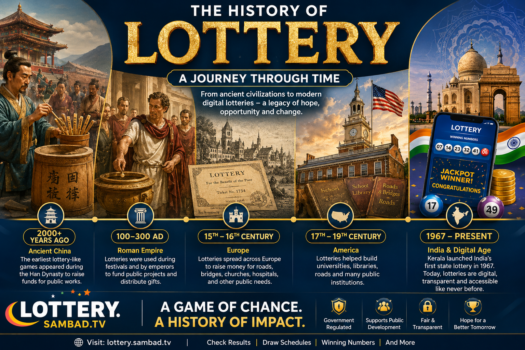
The Earliest Lottery in Ancient China
Many historians believe that the earliest known lottery-like game originated in ancient China during the Han Dynasty, around 205–187 BCE. A game similar to today’s Keno was reportedly used to raise funds for important public works.
Historical records suggest that money collected through these games may have contributed to major infrastructure projects. Although lottery systems in those days were very different from modern draws, the basic concept of randomly selecting winners already existed.
This early example demonstrates that lotteries were not only a source of entertainment but also a practical way to generate public revenue.
Lottery During the Roman Empire
The Romans also embraced lottery-style games. Wealthy citizens often organized prize drawings during banquets, where guests received gifts based on random selection.
Later, Roman emperors used lotteries to help finance public works and community improvements. These events became increasingly organized and popular among the public.
Although the prizes ranged from household goods to valuable items, the principle remained similar to today’s lottery draws—a fair random selection determined the winners.
Growth of Lotteries Across Europe
During the 15th century, lotteries became an important financial tool across several European countries.
Cities in present-day Belgium and the Netherlands organized public lotteries to raise money for building roads, bridges, churches, hospitals, and defensive walls. Instead of increasing taxes, governments found that voluntary lottery participation could help fund important civic projects.
England also introduced a national lottery during the reign of Queen Elizabeth I in 1569. Funds generated from ticket sales were used for improving ports, strengthening trade, and supporting national development.
These government-backed lotteries laid the foundation for many of today’s regulated lottery systems.
Lottery in Early America
Lotteries played a significant role in the development of colonial America.
Public lotteries helped finance roads, canals, bridges, libraries, and educational institutions. Several famous universities benefited from lottery funding during their early years, making lotteries an important source of public finance.
However, during the late nineteenth century, concerns about fraud and misuse caused many lottery systems to be suspended. Over time, governments introduced stronger regulations and transparent procedures, allowing legal state lotteries to return in many regions.
The Evolution of Lottery in India
India has its own rich lottery history.
The modern era of Indian lotteries began in 1967 when the Government of Kerala introduced the country’s first official state lottery. Its success inspired several other states to establish regulated lottery systems.
Today, states such as Nagaland, Sikkim, Punjab, Goa, and Mizoram operate legal government lotteries under their respective laws and regulations. Revenue generated through these lotteries may contribute to public welfare and development initiatives, depending on state policies.
It is important to note that lottery laws differ from one Indian state to another, and some states prohibit lotteries entirely.
The Digital Transformation
Technology has completely changed how people access lottery information.
Instead of waiting for newspapers or television announcements, players can now check lottery results online, view draw schedules, and access historical winning numbers within seconds.
Digital platforms have made lottery information faster and more accessible. However, users should always rely on official or authorized sources for accurate results and remain cautious of fraudulent websites or fake prize claims.
Why the Lottery Remains Popular
For centuries, lotteries have attracted people because of their simplicity. Participants purchase a ticket, wait for the draw, and hope their selected numbers match the winning combination.
Many people enjoy following lottery draws as a recreational activity, while others appreciate the excitement of participating in a long-standing tradition. Since every draw is random, no strategy can guarantee a win, and each ticket has its own independent chance according to the game’s rules.
Responsible participation is essential, and lottery games should always be viewed as entertainment rather than a source of income.
Conclusion
The history of the lottery is a fascinating journey through ancient civilizations, medieval Europe, colonial America, and modern India. What began as a simple method for distributing prizes and raising funds has evolved into sophisticated, government-regulated lottery systems supported by transparent drawing procedures and digital technology.
As lottery systems continue to modernize, their historical legacy remains an important part of their identity. Learning about this history helps us understand how lotteries have shaped public finance, community development, and entertainment across different cultures and generations.
For more informative articles, lottery news, draw schedules, and result updates, keep visiting Lottery.Sambad.TV.
Frequently Asked Questions
How old is the idea of lotteries?
Lotteries have existed in different forms for centuries, with governments and organisations historically using prize draws for revenue, public works or regulated entertainment.
How did modern state lotteries develop?
Modern lotteries became more formal through printed tickets, scheduled draws, regulated prize structures and official result publication.
Why is regulation important for lotteries?
Regulation helps define who may operate a lottery, how tickets are sold, how results are published and how prizes are claimed.
Are historical lottery practices the same as today?
No. Technology, regulation, ticket distribution and result verification have changed significantly, so current rules should be checked separately.
Lottery Sambad Blog
Read the latest Lottery Sambad guides, result updates, lottery information, claim process, tax details and useful tips.
Visit Lottery Sambad Blog